
Roman Garden News
This blog will carry periodic news bulletins on progress in the garden. For now, we catch up on 2026!
Winter/Spring 2026
After much research, the orchard has been planted. Many thanks go to those FORA members who donated a tree.
- Quince, sacred to Venus and an emblem of happiness, the fruits were eaten, generally cooked and considered beneficial for stomach complaints or dried and used as a restorative or room freshener.
- Medlar has a wide, spreading habit and its fruit was eaten or used to make wine.
- Cobnut or Hazel The Romans utilized hazel trees not only for nuts but also for their wood, which was commonly used for wattle fencing.
- Crab apple Britain’s only indigenous apple, grew in abundance in woodlands and hedgerows, making them accessible to the Romans upon their arrival. Although they preferred the sweeter, imported apples they introduced, the Romans used the tart, native crab apples to make vinegars, sauces, and for feeding pigs. They were associated with love, fertility, and marriage.
The soft fruit bed has also been planted, where the damson and fig trees are also to be found:
- Damson the fruits were eaten fresh or dried and when boiled the leaves were used to relieve mouth ailments.
- Fig Sacred to Romulus and Remus, as the she-wolf was reputed to have suckled them under a fig tree. Fig juice was used to curdle milk and was rubbed on meat to preserve and tenderise it. Fig wine and a syrup were used for their diuretic, laxative or sudorific properties.
- Rhubarb While the Romans knew of rhubarb and valued its roots as a medicinal purgative, they did not bring it to Britain for culinary use. It was usually imported from the East of the Empire.
- Blackberries and raspberries were either collected in the wild or used as protective hedges, rather than being grown in beds. In addition to their culinary properties, they were used to treat sore mouths and inflammation of the bowel.
- Strawberries were already growing in one of the herb beds, but the Romans did not cultivate them, just picked them in the wild.
On the negative side, part of the wall behind the soft fruit bed collapsed, but was quickly replaced by rabbit-proof fencing.
Bibliography: Roman Gardens and their plants by Claire Ryley, ISBN 0904973166.
In April, the garden came back to life:
- the return of the narcissi brought colour to the site;
- the newly planted orchard and soft fruit bed came into bud;
- the grassed areas were mown and the beds edged;
- the acanthus plants along the wall grew by the day;
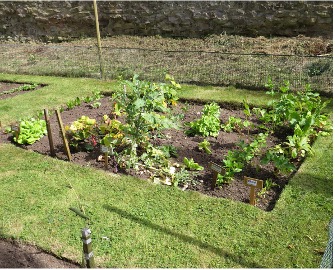
- most flowers and herbs overwintered well, but none of the vegetables, except leeks and garlic survived the wet winter and spring;
- peas, beetroot, purple carrots, parsnips, turnips, radishes, chicory were sown;
- red and brown onions and shallots were planted, and
- broad beans, lettuces and globe artichokes were growing well.